

Over the weekend, I attended my first-ever on-site American Political Science Association conference. I have avoided this conference for the 20+ years I’ve been in the discipline. Twice, I have participated in virtual components of the meeting, but I have assiduously avoided going to the in-person version.
When I wrote my book, The Present Professor, I described disciplinary conferences as landmines—places where my guard goes up and my more authentic self feels unsafe. That observation was based on my experiences at three different regional associations of political scientists, each of which I’ve attended multiple times. At those smaller (but not small) conferences, I’ve often found myself in rooms with just a handful of scholars who perpetuate the same norms I saw unfold when candidates gave job talks during my grad school days. Those norms, to put it mildly, are not kind.
I overheard conversations of folks having heated disagreements over a relatively minor matter of measurement; I witnessed women and scholars of color (and disabled, visibly divergent, or queer folks) gatekept out of conversations while the white dudes in khakis took up gobs of space in hotel lounges. I will never comfortably be able to exist in the Palmer House lounge area.
I went to the APSA conference this year for two reasons: First, I am currently serving on the Teaching and Learning Conference @ APSA (TLC@APSA) committee, which organizes a one-day mini-conference of teaching-centered research and roundtables. I organized papers for two panels on curriculum and assessment in political science education, so I was there to chair those panels and serve as a discussant for one. Second, I was selected to participate in a working group/roundtable on accessibility and disability in the profession, and attending those three 90-minute sessions was deeply important to/meaningful for me. I packed my bags and headed to Boston.
And it was…not (much) fun.
Reason #1: Sensory overwhelm
I’ve heard others talk about APSA as a deeply overwhelming experience, and I had no reason to doubt that it would be. Something like 7,000 people attend this conference, which always takes up multiple hotels (there’s a “housing bureau,” for heaven’s sake! I couldn’t even make a direct hotel reservation) and a convention center. Hundreds of panels. Dozens of receptions. People everywhere. I imagine that even neurotypicals would find this impossibly, dizzyingly taxing.
As an AuDHDer and a person with chronic back pain, the conference was—and this is not an exaggeration—an unmitigated disaster. Just navigating from my hotel room to pick up my badge involved a 15-minute walk through three buildings and a security checkpoint with metal detectors and bag checks. There were not many places to stop along the way to sit and rest.
Reason #2: Social isolation
It’s especially jarring to be in a place teeming with people and yet feel like there’s not really anyone there to connect with. Apart from my roundtable meetings with my fellow disabled political scientists and randomly running into one person (twice!) I knew from graduate school, I saw very few people I knew. In one case, I’d emailed a former mentor to try to arrange a coffee catch-up. They never responded. I’ll be feeling the sting of that for a long, long time.
My lone moment of social connection? It happened with a fellow educational developer who happens to live in Boston. In other words, not a political scientist.
Reason #3: What are we even doing?!
In my book, I wrote about overhearing a conversation at the Palmer House in Chicago between two congressional scholars debating the way we measure…something. It was a real lightning-bolt moment for me, one where I asked myself: “What are we even doing as a profession?!”
I think my feelings in this regard are best captured by a post I saw a fellow political scientist make on Bluesky. (Sadly, this was not someone with whom I crossed paths among the 7,000 folks attending…)
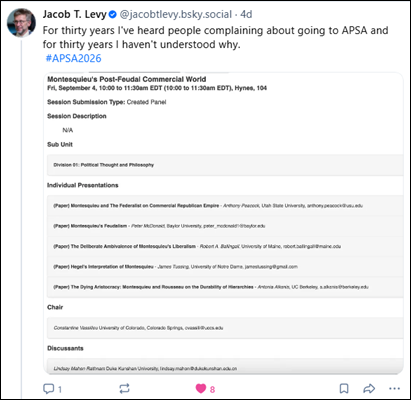
I mean no offense to the folks deeply concerned about Montesquieu’s thoughts on a post-feudal commercial world, but… OOF. It’s just not apparent to me why this, like, matters? Have we nothing more important to sort out in the year of our Lord 2026?!
Thank you, Jacob Levy, for posting this so I didn’t have to.
Reason #4: Seriously, Labor Day weekend?!
Leave it to political scientists to think that Labor Day weekend, which falls either right after or right before fall semester classes start, is the perfect time to have a gathering. Don’t we, as a profession, get lambasted for being too liberal? And yet, we plan a professional gathering during the holiday weekend where we’re NOT supposed to work? The one that exists because of unions?
Make it make sense. I cannot.
I’m really glad I met some fellow disabled political scientists. I’m glad I got to see my ed dev friend twice in a single year in Boston! I’m really grateful for the many folks who attended the conference and spent a whole day thinking about effective teaching and meaningful learning for our students.
But please, don’t ever make me do this again.